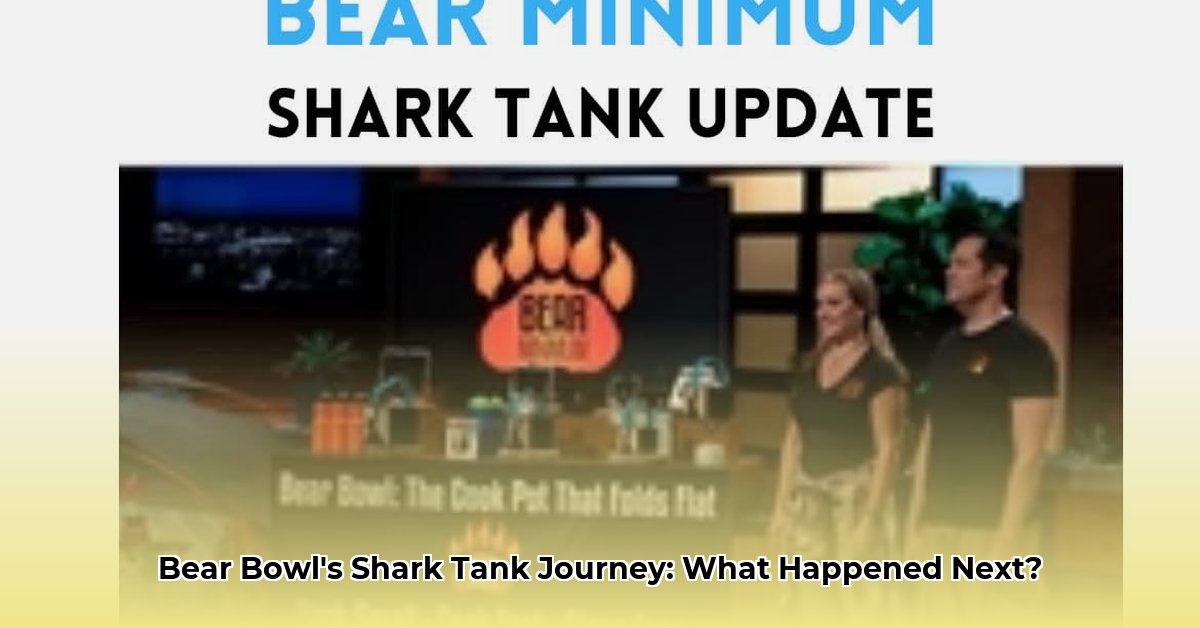
The Bear Bowl, a sustainable cookware set, captured national attention after its Shark Tank appearance. But what's the reality behind its post-show success, and what's the current estimated net worth? This case study analyses Bear Bowl's journey, encompassing its initial boom, subsequent challenges, and future prospects.
The Shark Tank Effect: Initial Success and Rapid Growth
Bear Minimum, the company behind the Bear Bowl, experienced a dramatic surge in sales following its Shark Tank debut. Daily orders increased exponentially, from a handful to approximately 100. This wasn't a short-lived phenomenon; successful crowdfunding campaigns on Kickstarter and Indiegogo further fueled growth, alongside positive media coverage in publications like Outside magazine. This initial success, however, masked significant underlying challenges.
Production Bottlenecks: A Roadblock to Growth
The rapid increase in demand quickly outpaced Bear Minimum's production capacity. Significant bottlenecks emerged, limiting sales and frustrating customers. Currently, only the smallest Bear Bowl ("Baby Bear Bowl") consistently remains in stock. This scarcity points to substantial supply chain issues and manufacturing capacity limitations. How can a company experiencing such explosive growth struggle to meet demand? This underscores the critical need for efficient scaling and robust supply chain management.
Jamie Siminoff's Investment: A Lack of Transparency
Bear Minimum secured an investment from Jamie Siminoff on Shark Tank. However, the details surrounding this investment remain surprisingly opaque. The lack of transparency regarding the investment terms and its impact hampers any precise assessment of its influence on the company's financial situation. This lack of information significantly limits our ability to accurately gauge Bear Minimum’s net worth.
Estimating Bear Minimum's Net Worth: A Calculated Approach
Determining Bear Minimum's precise net worth is currently impossible without access to their private financial records. However, we can make a reasoned estimate based on available data, including initial sales figures and the Shark Tank investment. Considering the initial sales boom followed by the severe production constraints, we can surmise a fluctuating net worth. The significant impact of supply chain challenges renders any specific figure unreliable at this time; more detailed financial transparency is crucial for a more accurate valuation.
Sustainability: A Core Value Facing Scalability Challenges
Bear Minimum's commitment to sustainability is a key differentiator. The bowls are designed for minimal environmental impact. However, scaling sustainable sourcing presents significant obstacles. Finding suppliers capable of meeting both quality and sustainability standards while maintaining sufficient volume proves to be a major hurdle in expanding production. This highlights the inherent complexities of balancing ethical operations with the demands of rapid growth.
Future Prospects: Navigating Challenges and Seizing Opportunities
Bear Minimum faces crucial decisions, with overcoming production bottlenecks as the top priority. This requires several steps: securing additional funding to expand manufacturing capacity, streamlining production processes, and diversifying its supply chains. Beyond this, expanding product lines beyond the Bear Bowl, forming strategic partnerships, and strengthening inventory management are essential for long-term viability and growth.
Actionable Intelligence and Risk Assessment
To better understand the path forward, a concise analysis of potential actions and associated risks is provided below:
| Stakeholder | Short-Term Actions | Long-Term Strategies | Potential Risks |
|---|---|---|---|
| Founders | Improve production efficiency; secure additional funding; enhance customer communication. | Diversify product offerings; establish strategic partnerships; bolster supply chain resilience. | Failure to secure funding; inability to scale production; market saturation. |
| Investors (Siminoff) | Offer mentorship and operational guidance; provide additional capital as needed. | Support innovation and expansion into new markets; long-term growth strategies. | Poor financial performance; lack of market adoption of new products. |
| Customers | Transparent communication regarding delivery times; improved customer service. | Expanded product selection; consistent product availability; unwavering product quality. | Customer churn due to delays and lack of product availability. |
| Competitors | Monitor Bear Minimum's actions; develop competitive sustainable product lines. | Innovation; aggressive marketing; competitive pricing. | Market share loss; intensifying competition. |
Conclusion: An Uncertain, Yet Promising, Future
Bear Minimum's Shark Tank appearance yielded initial success, but the company now faces significant challenges. Addressing production bottlenecks and increasing financial transparency are crucial for a successful future. The company's path forward is far from certain, but the potential for significant growth remains. The next few years will be pivotal in determining whether Bear Minimum can overcome these obstacles and become a leading brand in the sustainable cookware market.